Program to calculate LCM of two numbers
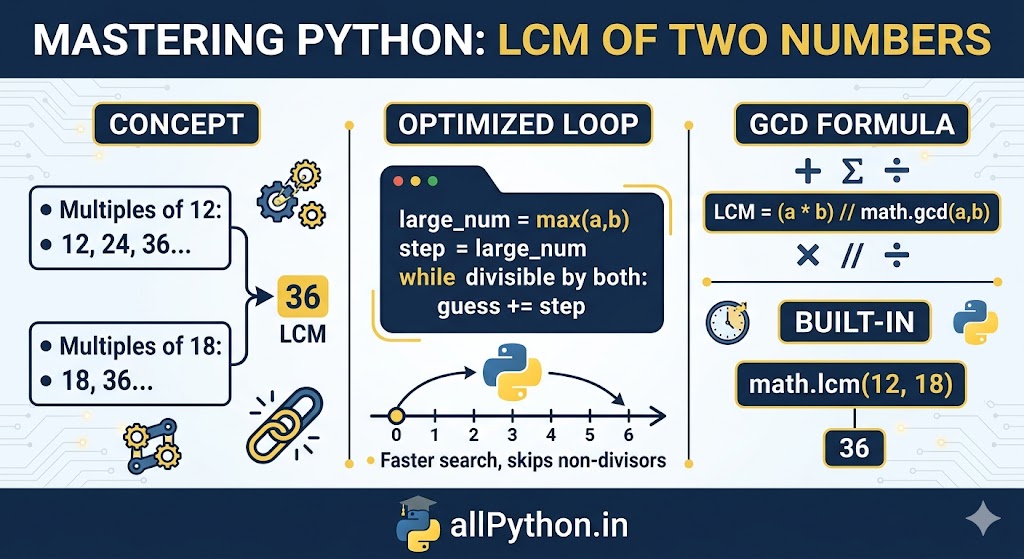
Calculating the Least Common Multiple (LCM) is a fundamental mathematical concept with countless applications in everyday programming, optimization, and advanced mathematical computations. In Python, you can achieve this through various approaches, from an optimized loop-based method to leveraging efficient mathematical properties like the Greatest Common Divisor (GCD). Let's dive into mastering LCM calculations simply.
1. Conceptual Understanding: Defining LCM
The Least Common Multiple (LCM) of two or more non-zero integers is the smallest non-zero common multiple of all the numbers. Intuitively, it's the first number that appears in the multiplication tables of both numbers.
Conceptual Visual Example: Multiples of 12 and 18
Let's look at the multiplication lists for 12 and 18:
- Multiples of 12: 12, 24, 36, 48, 60, 72, ...
- Multiples of 18: 18, 36, 54, 72, 90, ...
The common multiples are 36, 72, and so on. The least of these (the first common non-zero one) is 36. So, LCM(12, 18) = 36.
2. Implementation in Python: Method 1 (Optimized Loop)
This approach uses a loop, but with a crucial mathematical optimization. We know that the LCM must be a multiple of the larger of the two numbers. Therefore, instead of checking every single integer starting from 1, we can start our search at the larger number and increment our guess by the larger number in each step. This drastically reduces the number of checks we have to perform.
# Method 1: finding LCM using optimized loop stepping
num1 = int(input("Enter first number: "))
num2 = int(input("Enter second number: "))

# The LCM must be a multiple of the larger number
step = max(num1, num2)
guess = step

# Start a loop, checking only multiples of the larger number
while True:
    # Since 'guess' is already a multiple of the larger number,
    # we only strictly need to check divisibility by both to be safe and clear.
    if (guess % num1 == 0) and (guess % num2 == 0):
        lcm = guess
        break # First common multiple found, that's the LCM

    # Optimized increment: step by the larger number instead of +1
    guess += step

print(f"The LCM of {num1} and {num2} is {lcm}")
3. Mathematical Optimization: Method 2 (Using GCD Formula)
An even more efficient way to calculate the LCM uses its mathematical relationship with the Greatest Common Divisor (GCD), also known as the Highest Common Factor (HCF).
The Fundamental Formula:
LCM(a, b) * GCD(a, b) = a * bTherefore, we can easily find the LCM once we know the GCD:
LCM(a, b) = (a * b) / GCD(a, b)In Python, you can find the GCD efficiently using the built-in math.gcd() function. Once we have the GCD, the LCM is a simple calculation. We use integer division (//) to ensure the result is an integer.
# Method 2: efficient LCM calculation using GCD formula
import math

n1 = int(input("Enter first number: "))
n2 = int(input("Enter second number: "))

# Finding the GCD using built-in math.gcd()
g = math.gcd(n1, n2)

# Applying the formula for LCM
lcm = (n1 * n2) // g

print(f"The LCM of {n1} and {n2} is {lcm}")Starting from Python 3.9, the
math module includes a built-in math.lcm() function, allowing you to find the LCM directly and efficiently for any number of arguments without writing the formula manually.
import math
# Python 3.9+ direct LCM
print(math.lcm(12, 18)) # Output: 36
💡 Key Takeaways on Python LCM Calculations
- LCM is the smallest non-zero common multiple of two non-zero integers.
- Method 1 (Optimized Loop) stepping by the maximum value is highly intuitive and skips unnecessary calculations.
- Method 2 (Formula) leveraging GCD is the most mathematically efficient and scalable method for extremely large numbers.
- Formula:
LCM(a, b) = (a * b) // GCD(a, b). - Python 3.9+ offers a built-in
math.lcm()function for direct and fast calculation.