Program to find the Distance of a point from the Origin
Calculating the distance of a point from the origin (0,0) is a fundamental operation in computer graphics, game development, and machine learning. In Python, there are multiple ways to approach this, ranging from manual mathematical calculations to highly optimized built-in functions.
1. Conceptual Understanding: The Mathematics
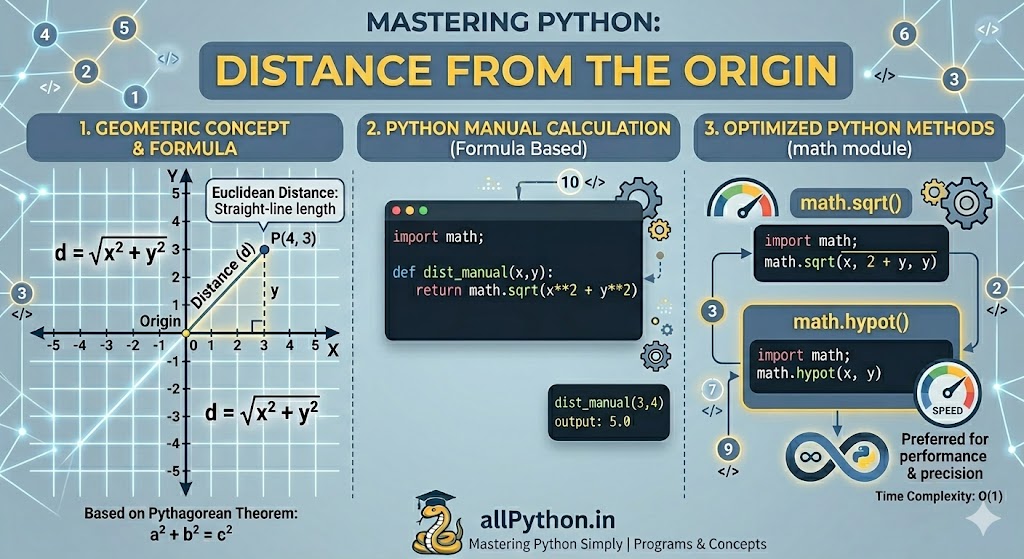
To find the straight-line distance between the origin (0, 0) and any given point (x, y) on a 2D Cartesian plane, we use the Euclidean Distance Formula. This formula is directly derived from the famous Pythagorean theorem.
If you draw a line from the origin to your point, and then draw vertical and horizontal lines to the axes, you form a right-angled triangle. The distance is simply the hypotenuse of that triangle!
2. Method 1: Using Basic Math Operators
We can translate the mathematical formula directly into Python using standard arithmetic operators. In Python, `**` is the exponentiation operator. Squaring a number is `x ** 2`, and taking the square root is equivalent to raising it to the power of 0.5 (`** 0.5`).
# Method 1: Manual calculation using standard operators
def manual_distance(x, y):
    # Calculate x squared plus y squared
    sum_of_squares = (x ** 2) + (y ** 2)

    # Calculate the square root
    distance = sum_of_squares ** 0.5
    return distance

# Example
x_val = 3
y_val = 4
dist = manual_distance(x_val, y_val)
print(f"The distance of ({x_val}, {y_val}) from the origin is {dist}")
# Output: The distance of (3, 4) from the origin is 5.0
3. Method 2: The Pythonic Way (math.hypot)
While doing the math manually is great for learning, Python provides a much better, faster, and safer way. The built-in math module has a function specifically designed for this exact calculation: math.hypot().
Not only is it less code to write, but it is also implemented in C under the hood, making it significantly faster. Furthermore, it handles special edge cases (like extremely large numbers or infinity) much better than manual calculation, preventing overflow errors.
# Method 2: Using the optimized math.hypot function
import math

def optimized_distance(x, y):
    # math.hypot automatically calculates the Euclidean norm
    return math.hypot(x, y)

# Take input from the user
try:
    user_x = float(input("Enter X coordinate: "))
    user_y = float(input("Enter Y coordinate: "))

    # Calculate and round to 2 decimal places for neatness
    result = round(math.hypot(user_x, user_y), 2)
    print(f"Distance from origin: {result}")

except ValueError:
    print("Please enter valid numerical coordinates.")
💡 Mind-Blowing Facts About Euclidean Distance
- Machine Learning Foundation: When a recommendation algorithm tries to find products or movies "similar" to what you like, it often treats your preferences as coordinates in a massive multi-dimensional space and calculates the Euclidean distance to find the "closest" matches!
- Beyond 2D: The beauty of this formula is that it scales to 3D space easily! The distance from the origin to a point in 3D space (x, y, z) is simply
√(x2 + y2 + z2).math.hypot()in Python actually supports multi-dimensional inputs natively!
Interactive Distance Explorer
Visualize the Euclidean Distance formula.
d = √(3² + 4²)
d = √(9 + 16)
d = √(25)
Distance = 5.00