Program to generate Fibonacci Series
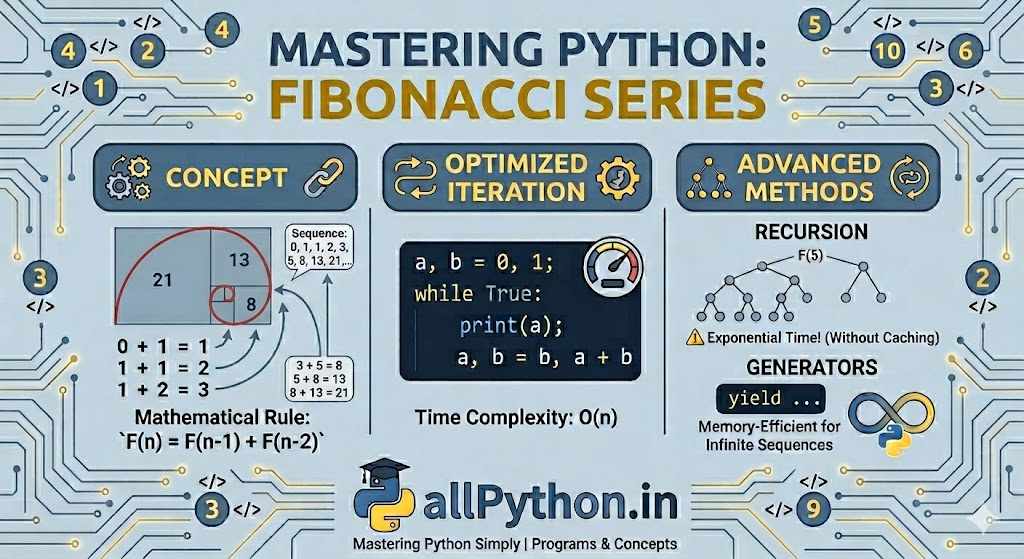
The Fibonacci sequence is one of the most famous number patterns in mathematics and computer science. It frequently appears in technical interviews to test a programmer's understanding of loops, variables, and recursion. In Python, there are several ways to generate this series, ranging from simple iterative loops to elegant generators. Let's break them down step-by-step.
1. Conceptual Understanding: What is the Fibonacci Series?
The Fibonacci series is a sequence of numbers where every number is the sum of the two preceding ones. By convention, the sequence typically starts with 0 and 1.
Mathematical Definition
Mathematically, the n-th Fibonacci number can be defined by the recurrence relation:
Fn = Fn-1 + Fn-2
With the initial seed values:
- F0 = 0
- F1 = 1
This results in the sequence: 0, 1, 1, 2, 3, 5, 8, 13, 21, 34, 55...
2. Method 1: Using an Iterative Loop (Most Efficient)
The iterative approach is the most common and efficient way to generate the series in production code. By using Python's simultaneous assignment feature, we can swap and update variables in a single, clean line without needing a temporary variable.
# Method 1: Iterative approach using a for loop
def fibonacci_iterative(n):
    # Starting values
    a, b = 0, 1
    series = []

    for _ in range(n):
        series.append(a)
        # Pythonic simultaneous assignment!
        a, b = b, a + b

    return series

terms = int(input("How many terms do you want? "))
if terms <= 0:
    print("Please enter a positive integer.")
else:
    print(f"Fibonacci series up to {terms} terms:")
    print(fibonacci_iterative(terms))
3. Method 2: Using Recursion (The Mathematical Way)
Recursion is a method where the function calls itself to solve a smaller instance of the same problem. This approach reads exactly like the mathematical definition, making it very elegant to read.
# Method 2: Finding the nth term using Recursion
def fibonacci_recursive(n):
    # Base cases
    if n <= 0:
        return 0
    elif n == 1:
        return 1
    # Recursive step
    else:
        return fibonacci_recursive(n-1) + fibonacci_recursive(n-2)

terms = 7
print(f"Fibonacci series up to {terms} terms:")
for i in range(terms):
print(fibonacci_recursive(i), end=" ")While recursive Fibonacci is beautiful, it is incredibly inefficient for large numbers. It has a time complexity of O(2n) because it recalculates the same values over and over again. To fix this, you would use a technique called Memoization (caching the results).
4. Method 3: Using a Python Generator (The Memory-Saver)
If you need to generate a massive number of Fibonacci terms (e.g., millions), storing them all in a list will crash your computer's memory. Python provides Generators using the yield keyword. Generators produce one item at a time, calculating the next value only when you ask for it.
# Method 3: Using a Generator for infinite sequences
def fibonacci_generator():
    a, b = 0, 1
    while True: # Infinite loop!
        yield a
        a, b = b, a + b

# Let's create the generator object
fib_gen = fibonacci_generator()

# Print the first 10 numbers one by one
print("Using Generator:")
for _ in range(10):
    print(next(fib_gen), end=" ")
💡 Mind-Blowing Facts About the Fibonacci Sequence
- Nature's Secret Code: The Fibonacci sequence appears everywhere in nature. The arrangement of leaves on a stem, the branching of trees, the uncurling of a fern, and the arrangement of seeds in a sunflower all strictly follow Fibonacci numbers.
- The Golden Ratio (φ): As the Fibonacci numbers get larger, the ratio of any two consecutive numbers (e.g., 55/34, or 89/55) gets closer and closer to the Golden Ratio, approximately 1.618034. This ratio is heavily used in art and architecture to create aesthetically pleasing proportions.
- Ancient Indian Origins: While named after the Italian mathematician Leonardo of Pisa (known as Fibonacci) who introduced it to Western European mathematics in 1202, the sequence was actually described earlier in Indian mathematics by Acharya Pingala as early as 200 BC in his work on Sanskrit prosody.