Subtraction Operator in Python (-)
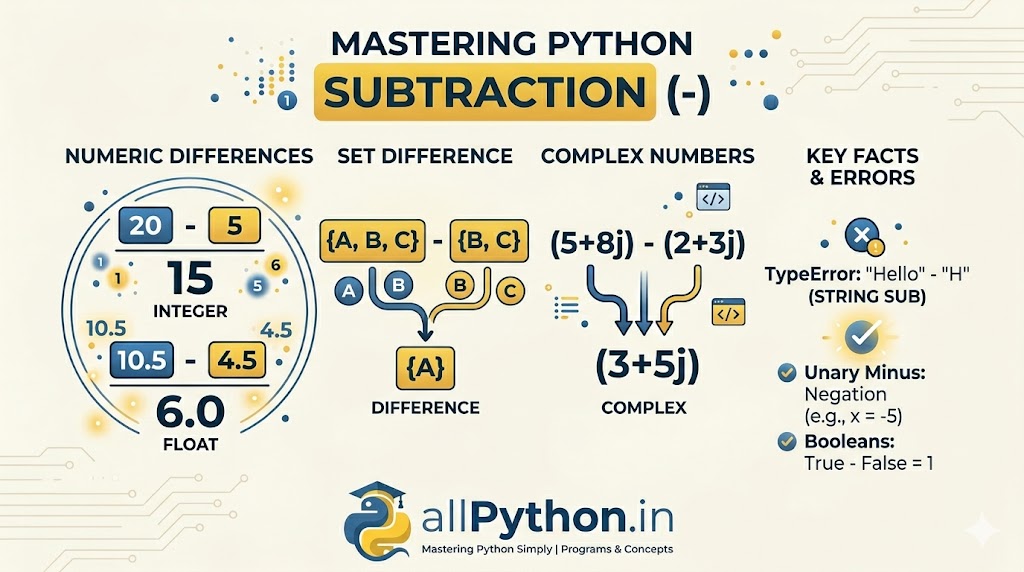
The Subtraction Operator (-) is a binary operator used to subtract the second operand from the first. In Python, it is versatile enough to handle simple integers, decimal numbers, and even complex mathematical values.
1. Basic Numeric Subtraction
Python performs subtraction between integers and floats with ease. When you subtract a float from an integer, the result is automatically converted to a float.
# Subtracting Integers
print(20 - 5)      # Output: 15

# Subtracting Floats
print(10.5 - 4.5)  # Output: 6.0

# Mixed types
print(10 - 2.5)    # Output: 7.5
2. Complex Number Subtraction
Just like addition, you can subtract complex numbers. Python subtracts the real parts and the imaginary parts separately.
c1 = 5 + 8j
c2 = 2 + 3j

print(c1 - c2)    # Output: (3+5j)
j for the imaginary part. Using i (as commonly used in math) will result in a NameError.
3. Set Difference
A unique feature of the - operator in Python is its use with **Sets**. It returns a new set containing elements that are in the first set but NOT in the second set.
set_a = {1, 2, 3, 4}
set_b = {3, 4, 5, 6}

# Elements in A but not in B
print(set_a - set_b)  # Output: {1, 2}
4. Strings
With string operand, the subtraction operation throws a TypeError (unsupported operand type). The following errors may be observed if any one operand is of type string.
- TypeError: unsupported operand type(s) for -: ‘str’ and ‘str’
- TypeError: unsupported operand type(s) for -: ‘str’ and ‘int’
- TypeError: unsupported operand type(s) for -: ‘int’ and ‘str’
- TypeError: unsupported operand type(s) for -: ‘str’ and ‘float’
- TypeError: unsupported operand type(s) for -: ‘float’ and ‘str’
- TypeError: unsupported operand type(s) for -: ‘str’ and ‘complex’
- TypeError: unsupported operand type(s) for -: ‘complex’ and ‘str’
5. Common Errors To Avoid
# "Hello" - "H"    # Raises TypeError
# [1, 2] - [1]     # Raises TypeError
💡 Interesting Facts
- Unary Minus: The
-symbol can also be used as a unary operator to negate a number (e.g.,x = -5). - Boolean Subtraction: Since
Trueis 1 andFalseis 0,True - Falseequals1. - Precision: Sometimes, subtracting floats can lead to tiny precision errors (e.g.,
1.1 - 1.0might result in0.10000000000000009).