Division Operator in Python (/)
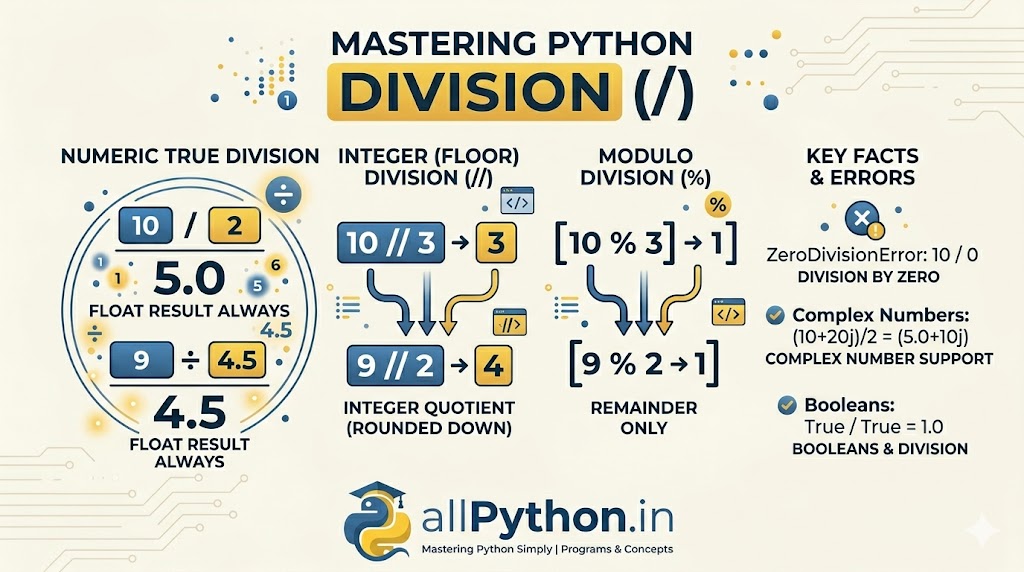
The Division Operator (/) is a critical arithmetic operator in Python used to find the quotient of two numbers. Python is unique among programming languages because it has two separate operators to handle standard division and integer-only division, making it important to understand exactly how the / operator behaves.
1. The Result is Always a Float
This is the most essential fact to remember about the / operator. In Python 3, using the standard division operator with integers, floats, or mixed numeric types will always produce a floating-point result, even if the division is clean.
# Dividing two integers cleanly
print(10 / 2)       # Output: 5.0 (Notice the .0)

# Dividing an integer and a float
print(10.5 / 2)     # Output: 5.25

# Standard mixed-type division
print(10 / 2.0)     # Output: 5.0
2. Handling Fractions and Precision
Python's division naturally produces fractional results without any extra steps. It handles deep precision well for most applications, although it's crucial to be aware of how binary floating-point arithmetic can sometimes cause tiny precision issues, which we'll cover in the facts section.
# Producing deep fractions
print(10 / 3)       # Output: 3.3333333333333335
print(1 / 3)        # Output: 0.3333333333333333
3. Complex Number Division
Just like other operators, you can divide complex numbers, where the division involves complex mathematical rules. This is another example of Python's comprehensive handling of numeric data types.
# Dividing complex numbers
print((5 + 8j) / 2)   # Output: (2.5+4j)
print((10 + 20j) / 2)  # Output: (5.0+10j)
4. Working with Booleans
In Python, True is treated as 1 and False is treated as 0. You can perform division with them, but be careful of the zero-value.
print(False / True)  # 0.0 / 1.0 -> Output: 0.0
print(True / True)   # 1.0 / 1.0 -> Output: 1.0
5. Related Operator: Integer (Floor) Division (//)
When you *only* want the integer quotient and don't care about the remainder, use the Floor Division Operator (//). It rounds the result down to the nearest whole integer, removing any fractional parts.
# Comparing standard and floor division
print(10 / 3)        # Output: 3.3333333333333335 (Float result)
print(10 // 3)       # Output: 3 (Integer result)
6. Strings
With string operand, the division operation throws a TypeError (unsupported operand type). The following errors may be observed if any one operand is of type string.
- TypeError: unsupported operand type(s) for /: ‘str’ and ‘str’
- TypeError: unsupported operand type(s) for /: ‘str’ and ‘int’
- TypeError: unsupported operand type(s) for /: ‘int’ and ‘str’
- TypeError: unsupported operand type(s) for /: ‘str’ and ‘float’
- TypeError: unsupported operand type(s) for /: ‘float’ and ‘str’
- TypeError: unsupported operand type(s) for /: ‘str’ and ‘complex’
- TypeError: unsupported operand type(s) for /: ‘complex’ and ‘str’
7. Common Errors To Avoid
ZeroDivisionError if you attempt it.
# print(10 / 0) # Raises ZeroDivisionError: division by zero# print("Python" / 2) # Raises TypeError💡 Interesting Facts
- Python 2 History: In Python 2,
/performed integer division if both operands were integers (e.g.,10 / 3was3). This was a frequent source of bugs, and Python 3 fixed it so/is always a true (float) division. - Float Precision Errors: Sometimes, performing arithmetic with floats can lead to tiny, counter-intuitive errors (e.g.,
1.1 - 1.0might result in0.10000000000000009). This is a result of how binary computers store floating-point numbers. For precise financial math, use the `decimal` module. - Division by True/False: Since
Trueis 1 andFalseis 0,10 / Trueis10.0and `10 / False` raises `ZeroDivisionError`.