Program to check if a number is Prime
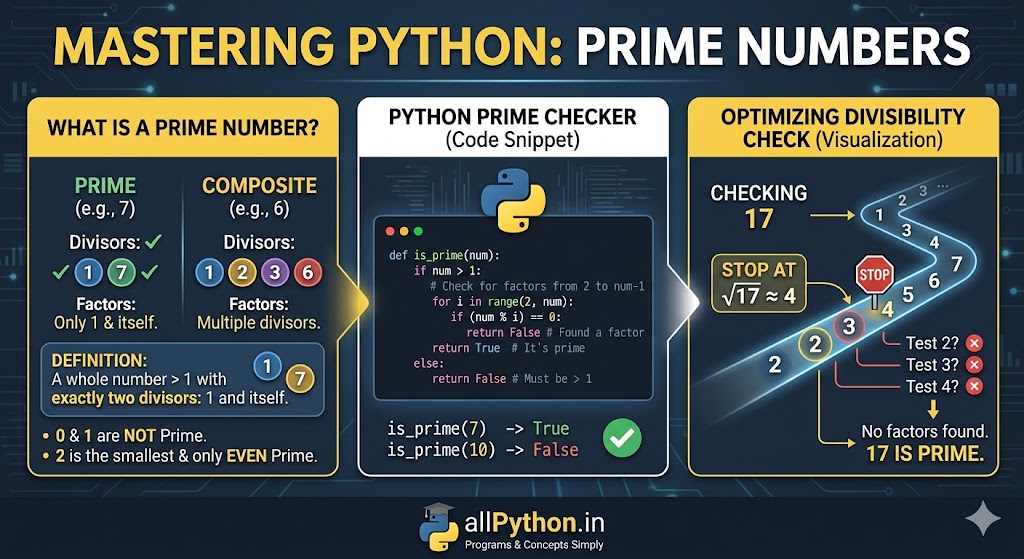
Prime numbers are the building blocks of mathematics and the foundation of modern computer cryptography. In Python, checking whether a number is prime is a classic programming exercise that tests your understanding of loops, conditionals, and algorithm optimization. Let's explore how to write this program, moving from a basic approach to a highly optimized one.
1. Conceptual Understanding: What is a Prime Number?
A Prime Number is a whole number strictly greater than 1 that has exactly two distinct positive divisors: 1 and itself. If a number can be divided evenly by any other number, it is considered a composite number.
The Rules of Primes:
- 0 and 1 are NOT prime numbers.
- 2 is the smallest and the only even prime number.
- Negative numbers are not considered prime.
- Examples of prime numbers: 2, 3, 5, 7, 11, 13, 17...
2. Method 1: The Basic Approach (Brute Force)
The simplest way to check if a number n is prime is to try dividing it by every integer from 2 up to n - 1. If any of these divisions result in a remainder of 0, the number is not prime.
# Method 1: Basic loop checking all numbers up to n-1
num = int(input("Enter a number to check: "))

# Primes must be greater than 1
if num > 1:
    # Iterate from 2 to n-1
    for i in range(2, num):
        if (num % i) == 0:
            print(f"{num} is NOT a prime number.")
            print(f"Because {i} times {num//i} is {num}")
            break
    else:
        # This else belongs to the FOR loop, not the IF!
        # It triggers only if the loop completes without breaking.
        print(f"{num} IS a prime number.")
else:
print(f"{num} is NOT a prime number.")This method works fine for small numbers. However, if you enter a number like
999,983, the loop will run nearly a million times just to confirm it's prime. This is highly inefficient!
3. Method 2: The Optimized Approach (Square Root)
We can drastically optimize our code with a simple mathematical rule: A number n can only have a unique factor up to its square root.
For example, to check if 36 is prime, you only need to check up to 6 (the square root of 36). Any factor pair larger than 6 will just be the reverse of a pair you already found (e.g., if you found 3 × 12, you don't need to check 12 × 3). This drastically reduces the number of loops needed!
# Method 2: Optimized loop up to the square root
import math

def is_prime_optimized(n):
    if n <= 1:
        return False
    if n == 2:
        return True # 2 is the only even prime
    if n % 2 == 0:
        return False # Eliminate all other even numbers instantly

    # Check odd numbers from 3 up to the square root of n
    max_divisor = math.isqrt(n)

    for i in range(3, max_divisor + 1, 2): # Step by 2 to skip evens
        if n % i == 0:
            return False

    return True

number = 999983
if is_prime_optimized(number):
    print(f"{number} IS a prime number.")
else:
    print(f"{number} is NOT a prime number.")
💡 Mind-Blowing Facts About Prime Numbers
- Internet Security Relies on Primes: When you buy something online or send a secure message, your data is encrypted using algorithms like RSA. RSA works by multiplying two absolutely massive prime numbers together. It is incredibly easy for computers to multiply them, but practically impossible to figure out what the original two primes were just by looking at the result!
- Infinitely Many: The ancient Greek mathematician Euclid proved over 2,000 years ago that there is no "largest" prime number; they go on forever.
- The Largest Known Prime: As of recent discoveries, the largest known prime number has tens of millions of digits! These are usually discovered by massive networks of computers hunting for "Mersenne primes" (primes in the form of 2p - 1).